A Dihybrid Cross Involves The Crossing Of Just One Trait. - Dihybrid Cross / A dihybrid cross is the cross that involves parents that differ in two traits.
A Dihybrid Cross Involves The Crossing Of Just One Trait. - Dihybrid Cross / A dihybrid cross is the cross that involves parents that differ in two traits.. An organism of genotype aabb can make gametes of all the following kinds except 10. Mendel invented the dihybrid cross to determine if different traits of pea plants, such as flower color and seed shape, were inherited independently. Using the probability method, calculate the likelihood of these phenotypes from each dihybrid cross: Basically, the idea is in monohybrid cross only one characteristic is the phenotypic ratio becomes 3:1. • a dihybrid is an individual that is heterozygous at two genes (yyrr).
Transcribed image text from this question. When crossing an organism that is homozygous recessive for a single trait with a heterozygote, what is the. Dihybrid cross procedure 11.2 the preceding cross involved only one trait and is thus called a monohybrid cross. • a dihybrid is an individual that is heterozygous at two genes (yyrr). Your instructor will review with you the basics for working genetics problems.

A piece of dna that provides a set of instructions to a cell to make a certain protein.
Thus, a dihybrid cross involves two pairs of genes. How to complete a dihybrid cross. A cross of parental types aabb and aabb can be represented with a punnett square: This video will show how to set up and solve everyone's favorite 16 square punnett square. D= dimples d= no dimples tongue rolling ability: At this time, crossing over moves sections of dna between homologous chromosomes and allows for independent assortment. The cross of these particular dihybrids produces four phenotypic classes. A piece of dna that provides a set of instructions to a cell to make a certain protein. Using the probability method, calculate the likelihood of these phenotypes from each dihybrid cross: A cyclops that is resistant to pesticides and has smooth antennae is crossed with one that is heterozygous for both traits. A dihybrid cross involves two traits, such as color and size. A dihybrid cross is simply an expansions of a punnet square to the point where the square depicts the independent assortment and expressions of there are crosses that can expand even further to fit more traits in the cross. Cross a flower that is heterozygous for both traits with another flower that is pink and tall.
It tells the outcome of just one trait. Considering a dihybrid cross, what is the probability of the progeny being heterozygous at both the alleles? Our objective is to understand the principles that govern. So thats often the reason. According to mendel's second law, the law of independent assortment , the inheritance of one trait will not affect the inheritance of another, meaning that alleles of each gene separate independently during gamete formation.
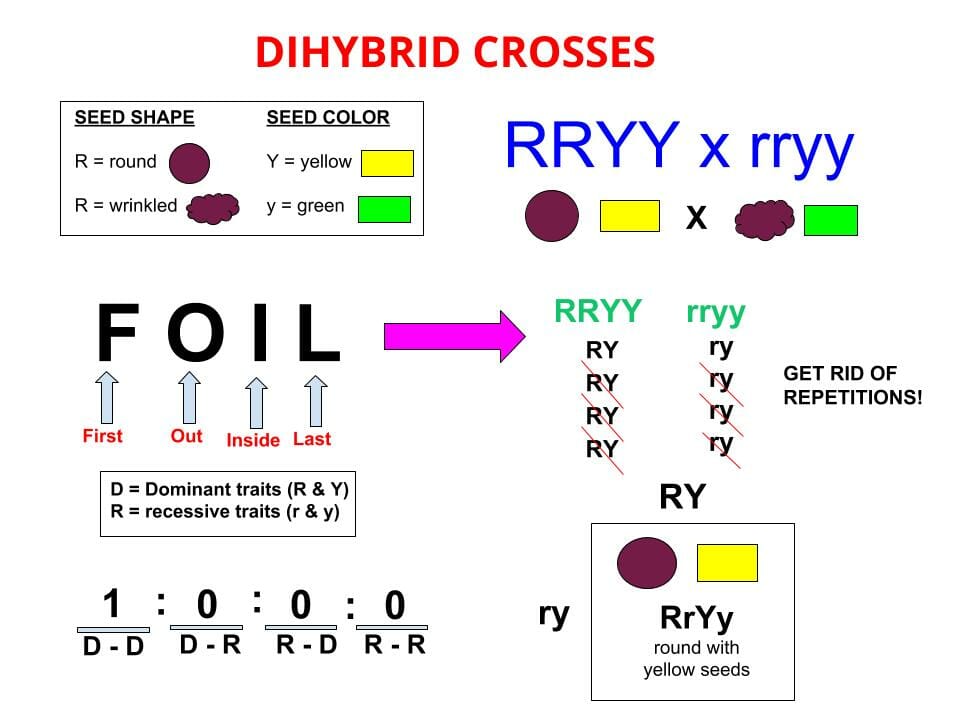
Our objective is to understand the principles that govern.
A dihybrid cross involves two traits, such as color and size. Particular chromosome when crossing over does not occur. Follow me and mark it as brainliest answer. • a dihybrid is an individual that is heterozygous at two genes (yyrr). How to complete a dihybrid cross. D= dimples d= no dimples tongue rolling ability: The cross of these particular dihybrids produces four phenotypic classes. A dihybrid cross is the cross that involves parents that differ in two traits. Dihybrid cross is a cross between two different lines/genes that differ in two observed traits. Recessive in the gene with alleles a and a from the cross. A dihybrid cross involves two traits. Given four possible gamete types in each parent, there are 4 x 4 = 16 possible f2 combinations, and the probability of any particular dihybrid type is 1/4 x 1/4 = 1/16. A dihybrid cross describes a mating experiment between two organisms that are identically hybrid for two traits.
An organism of genotype aabb can make gametes of all the following kinds except 10. Transcribed image text from this question. After he crossed peas with contrasting traits and found that the recessive trait resurfaced in the f 2 generation, mendel deduced that because of independent assortment and dominance, the 9:3:3:1 dihybrid phenotypic ratio can be collapsed into two 3:1 ratios, characteristic of any monohybrid cross. When crossing an organism that is homozygous recessive for a single trait with a heterozygote, what is the. This tutorial demonstrates how to find all possible gametes, explains the role.
This tutorial demonstrates how to find all possible gametes, explains the role.
E) a monohybrid cross results in a 9:3:3:1 ratio whereas a dihybrid cross gives a 3:1 ratio. The square is set up below. A) a monohybrid cross involves a single parent, whereas a dihybrid cross involves two parents. Cross a male heterozygous for dimples and tongue rolling ability with a female of the same genotype. Dihybrid cross is simply the cross between two pure species involving two pairs of gene. D= dimples d= no dimples tongue rolling ability: A cross of parental types aabb and aabb can be represented with a punnett square: Using the probability method, calculate the likelihood of these phenotypes from each dihybrid cross: This video will show how to set up and solve everyone's favorite 16 square punnett square. A cyclops that is resistant to pesticides and has smooth antennae is crossed with one that is heterozygous for both traits. This tutorial demonstrates how to find all possible gametes, explains the role. When crossing an organism that is homozygous recessive for a single trait with a heterozygote, what is the. A dihybrid cross is simply an expansions of a punnet square to the point where the square depicts the independent assortment and expressions of there are crosses that can expand even further to fit more traits in the cross.


Komentar
Posting Komentar